
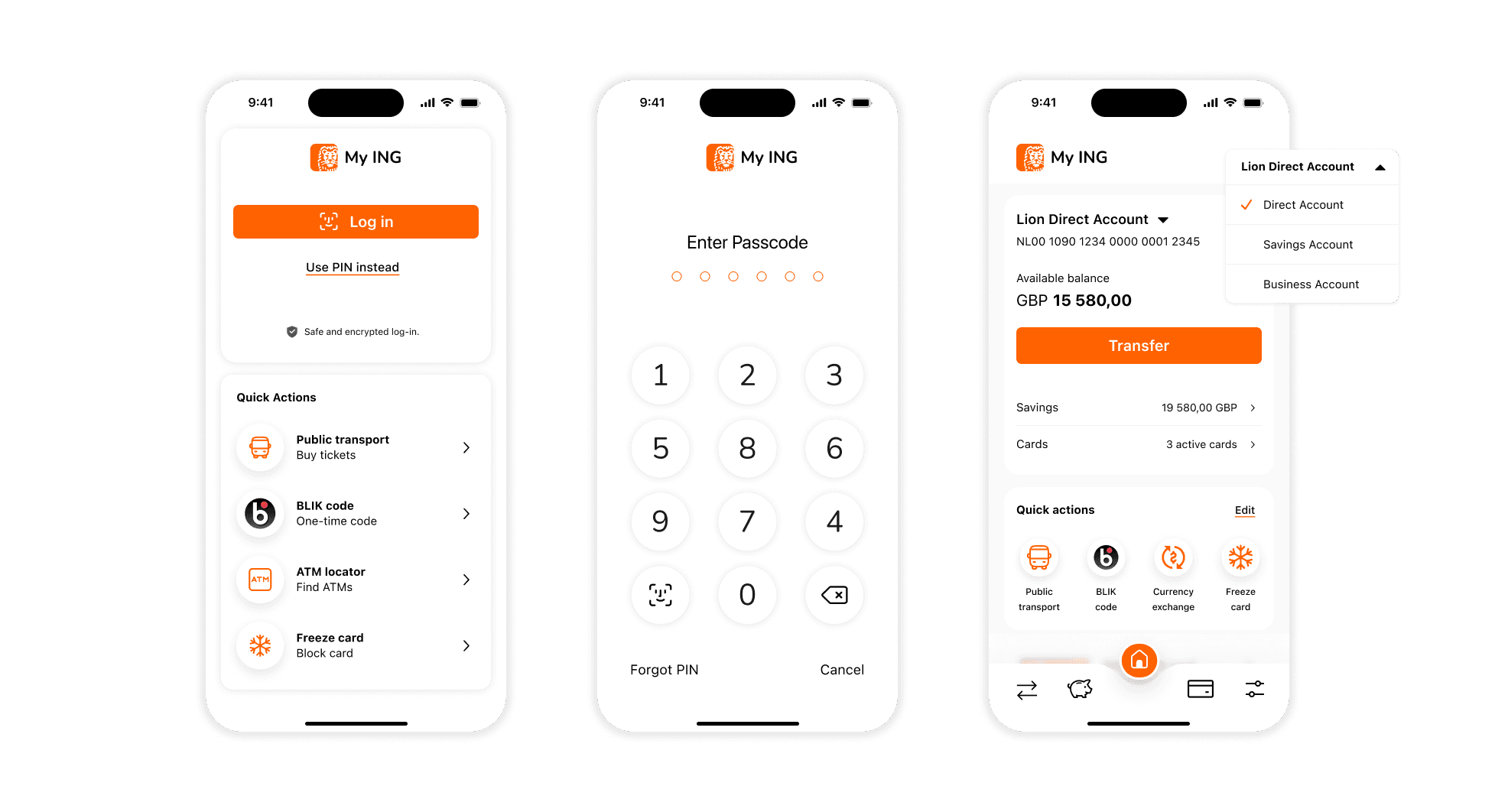
Clearer separation between public and secure zones
The pre-login experience should create a stronger boundary between public content and the regulated login flow. This improves trust, reduces ambiguity, and supports compliance clarity.
Lower cognitive load during login
Reducing the number of visible actions on the login entry screen helps users focus on a single goal: securely accessing their account.
Biometrics as an accelerator, not a primary feature
Face ID should support, not replace, PIN-based authentication. Keeping biometrics secondary aligns better with PSD2/SCA expectations and conservative banking patterns.
Simpler, more procedural login UI
Reducing visual richness on authentication screens increases predictability and lowers user stress during a high-risk moment.
Treat login as a security checkpoint, not an engagement surface
Login should prioritize speed, clarity, and trust over discovery or engagement. At the point of authentication, users need a focused path that clearly communicates security and control.
Context
This project explores a redesigned pre-login and login experience for a mobile banking app.
The goal was to balance strict regulatory requirements, including PSD2 and Strong Customer Authentication, with a calm, predictable daily banking experience.
Problem
Many banking apps combine marketing content, quick actions, and authentication entry points on a single screen.
This can create visual noise, blur the boundary between public and secure areas, and make it less clear when the user is entering a regulated flow.
At the same time, removing pre-login functionality entirely is not realistic, as users still need access to customer support, selected low-risk actions, and business-critical entry points.
Design goals
Clearly separate pre-login/public and login/secure areas
Make PIN-based authentication the foundation of the login flow
Support biometrics without making them dominant
Reduce cognitive load during authentication
Support PSD2/SCA requirements and accessibility compliance
